MEWAR PUBLIC SCHOOL
Uniara, Rajasthan, India
SINCE 2012
MPS
Monitoring and Evaluation


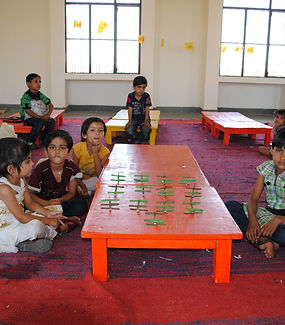
Activity-based Teaching
In the early part of life human learning is maximum when children interact with nature and do things with their hands. The teachers help the children learn to the fullest by facilitating activities and instructing them to interact with nature and one another, which is more effective than sitting in the classroom and memorizing letters, spellings, tables, formulas, etc.
Relevant Education
It is often said that what we study in school is not relevant to our day-to-day life. Its only use is to make us eligible for admission to higher education institutions. It is also true that many things which are relevant are left out of the standard curriculum. In fact, the design is such that the curriculum alienates the children from the local environment and society. In conclusion, the methodology in which things are taught is more important than providing bookish knowledge.
Syllabus and Text Books
When discussing the issues of relevant education--education based on scientific and rational values--we need to improve the syllabi. This is not about adopting a standard syllabus, it is better to evolve one over time after equipping the students with a solid foundation in basic knowledge (i.e.—alphabet, numbers, local plants, animals, industry, etc.). A relevant syllabus can only be created over a period where things are tried and critiqued. In some cases, the textbooks available do not include the important factors in any given subject. It is too common for teachers to teach and assess the info only found in textbooks. In turn, the students think that once they memorize the material, their work is done. They don’t comprehend the information so that they apply it outside the classroom. It would be better if the children were encouraged to read several books and were lead in interactive activities related to a particular topic or skill.
Mewar Public School does not have a system in which we fail the children, requiring them to repeat a grade level. Since we have taken the responsibility to educate the children, it is our responsibility that the child does not fail. If a child does not demonstrate the appropriate knowledge by the end of the year, it is we who have failed in the job we have assigned for the children. Monitoring and evaluation is a continuous process. Therefore there should be continuous and comprehensive planning and evaluation. Evaluation and planning should be treated as an integral part of the teaching-learning process. Furthermore, evaluation should provide the type of feedback on student achievement that enables teachers to improve their methodology if required. We practice a system of planning based on teacher evaluation that occurs on a daily basis.
ARTS AT MPS
Fine Arts and Performing Arts as subjects in school. Fine and performing arts enables the children to explore alternative ways of communication. It makes a vital contribution to the development of a range of intelligences, creative thinking, imagination, sensitivity, adoptability and risk taking capacities. It helps the child to understand the world better. Arts not only build a sense of confidence but also develop a speculative, solution-seeking and questioning frame of mind, and it makes the child emotionally strong and able to deal with feelings through experiential learning.